‘Six Weeks or Death’: Who is Sonam Wangchuk, and Why is He Fasting?
A profound and tense standoff is unfolding at the heart of India’s capital. Renowned educator, innovator, and climate activist Sonam Wangchuk has entered the third week of a grueling indefinite hunger strike at Delhi’s Jantar Mantar.
Declaring that his fast could last “six weeks unless he dies first,” Wangchuk’s rapidly deteriorating health has sent shockwaves across the nation, drawing urgent appeals from public figures, politicians, and ordinary citizens alike.
But who exactly is the man behind this ultimate sacrifice, and what has driven him to put his life on the line?
Who is Sonam Wangchuk?
To millions worldwide, Sonam Wangchuk, 59, is known as the real-life inspiration behind the character Phunsukh Wangdu in the Bollywood blockbuster film 3 Idiots. Yet, his actual achievements are far more expansive than any cinematic portrayal.
An engineer turned education reformer from Ladakh, Wangchuk has spent decades transforming rural education through the Students’ Educational and Cultural Movement of Ladakh (SECMOL), an institution that flipped traditional rote-learning on its head. He is also globally celebrated for inventing the “Ice Stupa”—an ingenious artificial glacier technology that stores winter water to help high-altitude Himalayan farmers combat acute spring water shortages caused by climate change.
Awarded the prestigious Ramon Magsaysay Award for his community leadership and innovation, Wangchuk has transitioned in recent years into one of India’s most visible champions for the environment and democratic rights.
Why is He Fasting?
Wangchuk’s current protest at Jantar Mantar is a unique, two-fold agitation addressing both national youth anxieties and the unresolved political future of his home region, Ladakh.
1. In Solidarity with India’s Stressed Youth
Wangchuk joined an ongoing agitation initiated by the Cockroach Janta Party (CJP)—a youth-centric movement led by 30-year-old Abhijeet Dipke that has rapidly amassed millions of followers online. The primary demand is immediate accountability regarding massive paper leaks and irregularities in national competitive examinations, specifically the NEET-UG medical entrance test.
The controversy has pushed the student community into a deep crisis, tragically linked to multiple student suicides. Wangchuk has taken up this mantle to demand the resignation of Union Education Minister Dharmendra Pradhan and financial compensation for the grieving families of the affected aspirants.
“We are sitting here to prevent such situations… It should not happen that next year the number rises,” Wangchuk stated, emphasizing the need to rebuild trust within India’s education infrastructure.
2. The Democratic Rights of Ladakh
Simultaneously, Wangchuk is continuing his long-standing fight for the constitutional future of Ladakh. Following the 2019 bifurcation of Jammu and Kashmir, which turned Ladakh into a Union Territory, locals have grown increasingly worried about bureaucratic overreach, cultural dilution, and ecological vulnerability.
Wangchuk is urging the Central government to finalize pending resolutions—specifically granting full statehood to Ladakh and extending protections under the Sixth Schedule of the Indian Constitution, ensuring the region is governed by a democratic setup rather than central bureaucracy.
The Toll of the Fast
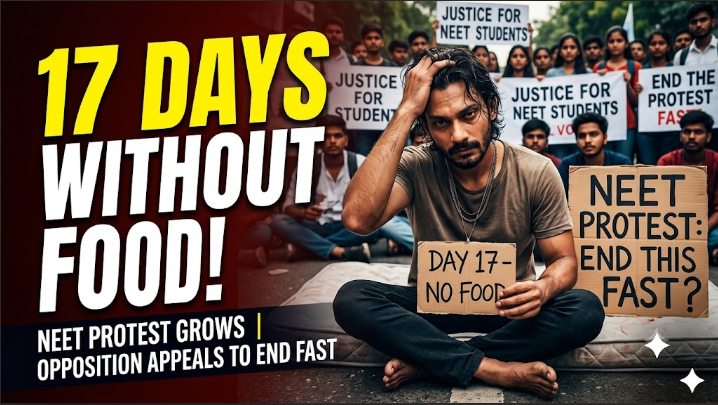
As the strike crosses Day 17, the physical toll on the 59-year-old activist has become alarming. Organizers report that Wangchuk has lost over 8.2 kilograms, with his muscle mass visibly depleting and his blood glucose levels dropping to critical zones. Medical teams are monitoring him closely, and a Public Interest Litigation (PIL) has even been filed in the Delhi High Court seeking emergency medical intervention and force-feeding to ensure he does not suffer irreversible organ damage or death.
Despite his body breaking down, Wangchuk remains resolute, recently noting that while his bones are beginning to show, his spirit remains firm. When urged by activists and icons like Arundhati Roy, Naseeruddin Shah, and Zeenat Aman to preserve his life, his message back has been unwavering: Don’t ask me to end my fast. Ask the government why they won’t open a dialogue.
Rejecting comparisons to historical figures, Wangchuk released a video statement emphasizing collective action:
“Many people call me a modern Gandhi or a hero. These comments make me uncomfortable… Please don’t look for a hero in someone else. Be the hero of your own life. Fulfill your responsibilities as a citizen.”
What Lies Ahead?
The protest is rapidly building toward a crucial flashpoint. Organizers have called for a massive, peaceful march to Parliament scheduled for July 20, aligning with the opening day of the Monsoon Session. Wangchuk and youth leaders are actively inviting students, parents, and citizens nationwide to join them—not to fast, but to stand as a unified front demanding swift governance, structural transparency, and the protection of constitutional rights.